
Smaller organisations are not behind on AI agents because the technology is out of reach. They are behind because large enterprises moved and they did not. In 2026, 40 percent of organisations above one billion dollars in revenue report scaling AI agents, up from 27 percent a year earlier. Among smaller organisations, the figure did not move at all. It stayed at 22 percent.
What happened to AI agent adoption in 2026?
McKinsey has run its State of AI survey every year for years. That history matters, since the year-on-year change tells you more than any single figure in it.
Notably, the 2026 edition says firms are moving past pilots. Nearly nine in ten now report regular use of AI in at least one part of the business. Moreover, 44 percent say AI is scaling across the enterprise, up from 38 percent a year earlier.
Under that headline, however, the picture splits sharply by firm size. We found that split by reading both editions together, and we built the chart below from the two cohort figures. The table under it is our own maths.
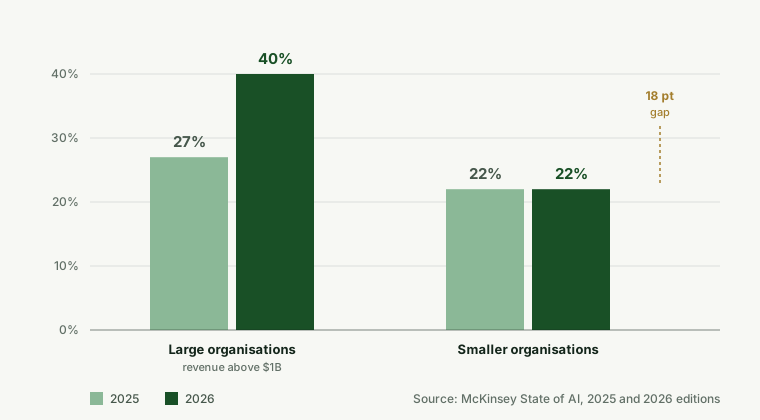
| Cohort | Scaling AI agents, 2025 | Scaling AI agents, 2026 | Movement |
|---|---|---|---|
| Large organisations, revenue above $1B | 27% | 40% | Up 13 points |
| Smaller organisations | 22% | 22% | No change |
| Gap between cohorts | 5 points | 18 points | Widened 13 points |
Source: McKinsey, The state of AI in 2026: On the road to ROI, August 2026.
The gap widened by standing still
From our analysis of both editions, two things stand out. First, the gap did not widen because smaller companies went backwards. Instead, it widened because they stood still while everyone else moved.
Second, 22 percent is not a small number. In fact, about one smaller firm in five is already scaling agents in at least one area. Thus the claim that this is only an enterprise concern is hard to sustain.
Why do published adoption figures disagree so wildly?
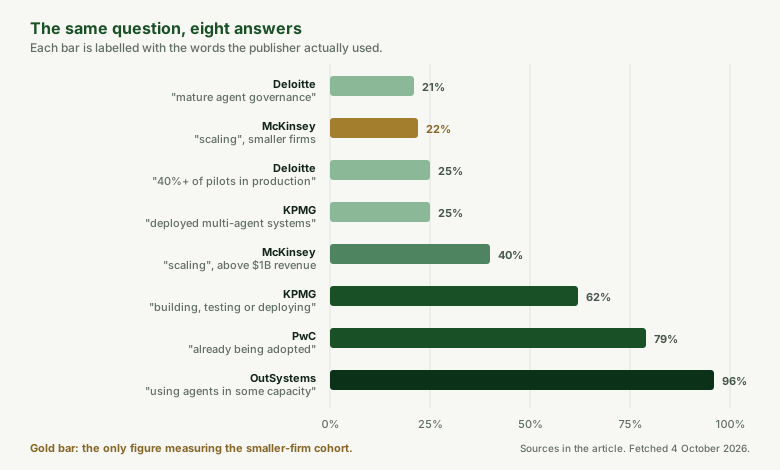
Here is why the 22 percent figure is hard to find. Depending on which survey you read, "AI agent adoption" is somewhere between 21 and 96 percent. We fetched all eight of the surveys below from the publisher's own page and confirmed each figure was actually there. The table puts each one's exact wording next to its number, because that is the thing almost nobody reproduces when they quote these.
| Publisher | Published | Sample | The exact wording used | Figure |
|---|---|---|---|---|
| Deloitte | Jan 2026 | 3,235 leaders, 24 countries | "mature model for agent governance" | 21% |
| McKinsey | Aug 2026 | 1,993 participants | "scaling AI agents", smaller organisations | 22% |
| Deloitte | Jan 2026 | 3,235 leaders | "moved 40% or more of their AI pilots into production" | 25% |
| KPMG | Sep 2026 | not stated on the page | "deployed multi-agent systems" | 25% |
| McKinsey | Aug 2026 | 1,993 participants | "scaling AI agents", revenue above $1B | 40% |
| KPMG | Sep 2026 | not stated on the page | "building, testing, or deploying AI agents" | 62% |
| PwC | May 2025 | 308 US executives | "already being adopted in their companies" | 79% |
| OutSystems | Apr 2026 | 1,900 global IT leaders | "using AI agents in some capacity" | 96% |
| OutSystems | Apr 2026 | 1,900 global IT leaders | "implemented a centralized platform to manage sprawl" | 12% |
| Google Cloud | 2026 | 3,466 global executives | agents in production | Not published openly |
The verb does more work than the number
Read the wording column on its own and the spread stops looking like disagreement. Scaling is not deploying. Deploying is not building or testing. Building or testing is not using in some capacity. Those are five different claims about five different thresholds, and they are reported as though they were one. A firm that reads the 96 percent figure concludes it is almost alone in not having agents. Read against the figure that actually measures its own cohort, 22 percent, the same firm is in the majority. Neither number is wrong. The number that matters is the one whose definition matches the decision you are about to make, and in practice that is almost never the headline figure a vendor quotes at you.
One row is worth singling out. The Google Cloud report is widely cited for a figure on agents in production, and we could not verify it, because the report sits behind a download form. So that row says "not published openly" rather than repeating a number we could not see. A blank row would have been easier and less honest.
A correction worth publishing
While checking the PwC figures we found that its own page disagrees with itself. The summary refers to "the 300 senior executives in our May 2025 survey". The methodology states 308 US business executives surveyed between 22 and 28 April 2025. We use 308 and April throughout, because that is the methodology note rather than the rounded summary. It is a small discrepancy and it matters only because this is exactly the sort of detail that degrades as a figure gets copied from one article to the next. By the fourth hop, a 308-person April survey has become "a 2025 study of 300 executives" and the sample has quietly become unverifiable. We mention it because we nearly repeated the rounded figure ourselves, having read the summary before the methodology note, and we caught it only by fetching the page to confirm the number.
What is an AI agent, exactly?
The word agent is doing a lot of work in current marketing, so it is worth being exact before drawing conclusions from adoption data.
An AI agent is a software system that interprets a goal, decides which steps to take to reach it, reads from and writes to business systems, and escalates to a person when judgement is required. Unlike rule-based automation, it is not given the sequence of steps in advance.
Rule-based automation is a fixed instruction of the form when this happens, do that. It is deterministic, so the same input always produces the same output.
Agentic AI is, in other words, the wider craft of building such agents around defined business steps. Notably, that usually keeps a human in the loop where judgement matters.
Agents compared with rule-based automation
That split matters for cost. The two tools fail in different ways, and they cost different amounts to run.
| Rule-based automation | AI agent | |
|---|---|---|
| How it decides | Fixed rules defined in advance | Interprets the goal at run time |
| Handles variation | Poorly, breaks on unexpected input | Well, adapts to the case |
| Cost to build | Lower | Higher |
| Cost to run | Near zero | Per-call model cost |
| Predictability | High, same input gives same output | Lower, needs evaluation and guardrails |
| Best suited to | Repetitive, predictable, high-volume steps | Multi-step work involving judgement |
Most real systems use both. For example, a quote request might be caught by a rule, read and sorted by an agent, then written back to a CRM by another rule. Our AI automation work and agentic AI work are deliberately separate services for that reason.
What returns do companies actually report?
None of this says agents do not work. On the other hand, the reported benefits look practical rather than speculative. Here is what PwC found among companies that had adopted agents:
- 66 percent reported increased productivity
- 57 percent reported cost savings
- 55 percent reported faster decision-making
- 54 percent reported improved customer experience
Two caveats belong next to those numbers. They are self-reported by bosses, not checked by anyone else. They also describe firms that chose to adopt agents, which is not a random sample. That said, the value shows up in time and cost, which a smaller firm can measure without a research team.
However, the same survey found that fewer than half of those companies changed anything structural about how work happens. Forty-five percent were rethinking operating models. Only 42 percent were redesigning processes around the agents they had deployed.
42%
of companies adopting AI agents are redesigning their business processes around them.
Deloitte found the same shape from a different angle. In its 2026 survey of 3,235 business and IT leaders across 24 countries, only 25 percent had moved 40 percent or more of their AI pilots into production, and only 21 percent reported a mature model for agent governance. Read those two alongside PwC's 42 percent and a consistent picture appears. The technology is bought widely and absorbed narrowly. Most organisations acquired agents and pointed them at the process they already had, which is why so many of them are stuck between a pilot that worked and a system nobody uses. Notably, all three figures come from different firms, different samples and different months, which makes the agreement between them more interesting than any one of them on its own.
Why is process design the real constraint?
Put the surveys side by side and the constraint stops looking technical.
Large enterprises did not advance 13 points because they got better models. The models are broadly the same ones available to everyone, often through the same public APIs. What big firms have instead is the ability to define a step clearly enough that software can run it. In practice that means somebody owns the process and can say what done right looks like. That one condition is the real prerequisite, and it is where most projects quietly fail. An agent given a vague goal will not stop and ask. It will pick one reading and apply it at volume until somebody notices. Thus the firms reporting value are mostly the ones that did the dull work of writing the process down first, and the ones reporting disappointment are mostly the ones that bought a tool and hoped the process would sort itself out.
That said, this is good news for a smaller firm. In fact, writing the process down is the cheapest part of the job. It needs attention, not budget.
A company of thirty people can map how a quote moves from enquiry to signature in an afternoon. By contrast, a company of thirty thousand needs a project to do the same thing. Smaller firms also hold two edges that rarely get counted. They have fewer systems to join up, and shorter sign-off chains. Hence both cut the cost of the part big firms find hardest. The problems we see most often are set out by symptom rather than by technology for the same reason: the symptom is the thing an owner can actually recognise, and the right tool follows from it rather than leading it. That ordering is also the cheapest insurance against buying the wrong thing, because a symptom you can describe is a requirement you can test a proposal against.
Where should a small business start?
If the binding constraint is process clarity, the order of work follows. This is the sequence we use when we scope an engagement.
-
Pick the process that costs the most hours, not the one that sounds most advanced. The hours are the business case. Without a baseline measurement, there is no way to tell afterwards whether anything improved.
-
Write down what correct looks like. If the people doing the work disagree about the right outcome, no agent will resolve that disagreement for them.
-
Decide what stays human. Big client messages, payments above a set limit and anything with a legal risk are the usual checkpoints.
-
Use the cheaper tool where it fits. If a step is predictable, a rule is more reliable and costs less to run than an agent.
-
Measure against the baseline from step one. Not against a vendor benchmark, and not against the impression that things feel faster.
That sequence mirrors how we work. Where the answer turns out to be a pipeline and follow-up problem rather than an agent problem, it is CRM work. Where it needs dashboards, portals or a layer between systems that do not talk, it is enterprise systems. Where nothing off-the-shelf fits, it is a custom build.
Cost, sequencing and staffing questions
Three questions come up in every scoping conversation often enough to answer here.
How much does it cost? Scope varies too much for a single useful figure. The more reliable question is which single process costs you the most hours per month, because that sets the ceiling on what automating it can be worth.
Why do most agent projects fail? PwC's 42 percent is the short answer. An agent pointed at a broken process automates the breakage, so the failure is usually in the scoping rather than the model.
Do agents replace employees? In current practice they do not. Deloitte's finding that only 21 percent of organisations have mature agent governance suggests most firms are nowhere near removing the human, whatever they intended.
What does the 2026 data not tell us?
Three limits on these numbers
Three limits are worth stating, because these numbers get quoted past what they support.
First, the McKinsey figures measure scaling, which is self-reported, not audited. Second, the PwC figures come from 308 US bosses in one month of 2025. That is a narrow base for global claims. Third, neither survey asks whether the money spent came back. None of the eight surveys in our table answers it.
What the data does support is narrower, but still useful. The firms reporting value are mostly the ones that changed the process, not just the tool. And the smaller-firm group did not move at all in 2026. Thus the gap is a choice now, not a limit.
Gartner has separately projected that a large share of enterprise applications will ship with task-specific agents built in. We have not checked that forecast ourselves, so it carries no figure here.
If working out which of your processes would survive that test is the hard part, that is what our free automation audit is for.
Frequently asked questions
Are AI agents only viable for large enterprises?
No. The 2026 McKinsey survey shows 22 percent of smaller organisations already scaling AI agents in at least one function. The gap against large enterprises is one of adoption pace, not technical feasibility. Smaller firms also have fewer systems to join up and shorter sign-off chains, which are real advantages once a process is clearly defined.
Why do published AI agent adoption figures disagree so much?
Because they measure different verbs. Across eight surveys we fetched, the figures run from 21 to 96 percent. Scaling, deployed, building or testing, adopted, and using in some capacity are five different claims. The numbers get quoted interchangeably, which makes the category look either further ahead or further behind than it is.
Which business processes should a small company automate first?
Start with work that is high volume, has clear success criteria, has recoverable errors, and already has its data in a system. Invoice processing, lead capture and routing, and support ticket triage all meet those tests. Avoid starting with high-stakes, customer-facing or compliance-sensitive processes.
Sources
Every figure above traces to one of these, and each was fetched from the publisher's own page on 4 October 2026 and returned a live response with the figure present.
- McKinsey, The state of AI in 2026: On the road to ROI, August 2026. Source for 40, 27, 22, 44 and 38 percent.
- PwC, AI Agent Survey, 16 May 2025, 308 US executives surveyed 22 to 28 April 2025. Source for 79, 66, 57, 55, 54, 45 and 42 percent.
- KPMG, AI Quarterly Pulse Survey, 25 September 2026. Source for 62 and 25 percent. Sample size not stated.
- Deloitte, State of AI in the Enterprise, 2026 edition, January 2026, 3,235 leaders across 24 countries, surveyed August to September 2025. Source for 25 and 21 percent.
- OutSystems, 2026 State of AI Development, 7 April 2026, 1,900 global IT leaders. Source for 96 and 12 percent.
- Google Cloud, AI agent trends 2026, 3,466 global executives. Gated. No figure quoted.
The year-over-year cohort table, the chart and the 18 point gap are our own calculation from the two McKinsey figures. They are not presented that way in the original report.
Fact-check note. Every figure quoted here was confirmed present at the cited URL on 4 October 2026. Where a figure could not be verified at the primary source it was omitted rather than softened, which is why no Gartner number appears in any table. More on how we approach numbers is on our about page. If you believe a figure here is wrong, please contact us and we will correct it.